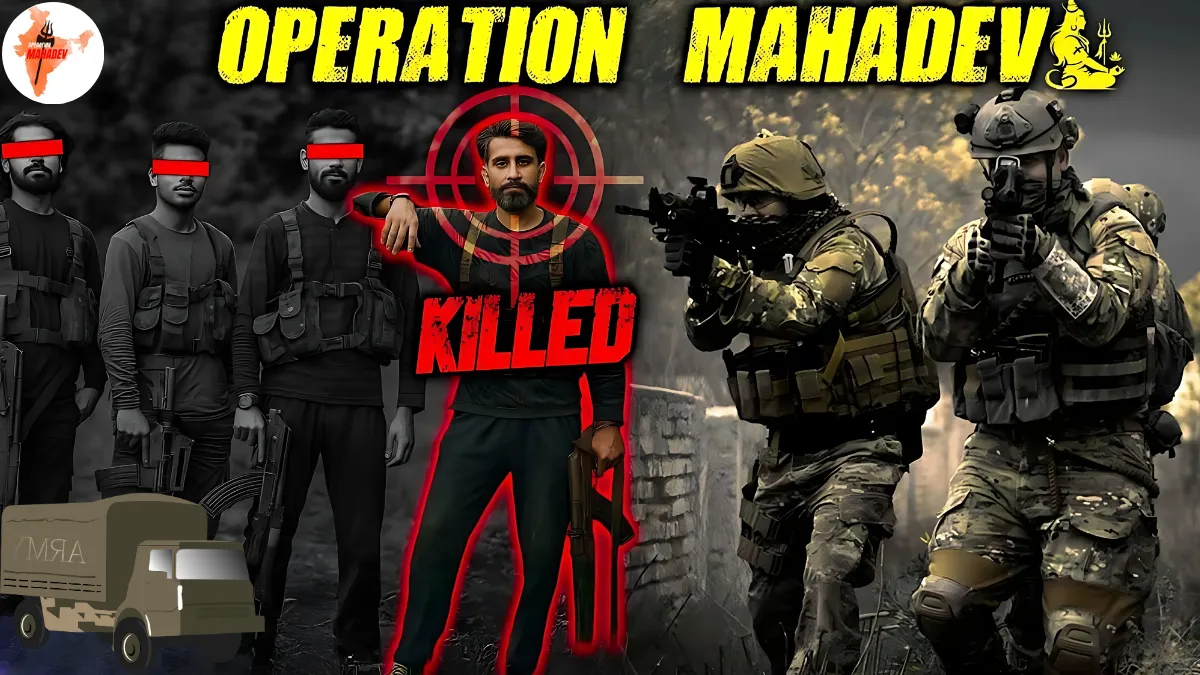
Operation Mahadev stands as one of India’s most decisive and calculated counter-terror missions—a strategic and moral response to the Pahalgam terror attack that shook the nation in April 2025. Executed with stealth, speed, and surgical precision, this operation redefined India’s internal security doctrine. It not only brought swift justice to the victims but also reinforced the nation’s zero-tolerance policy toward terrorism, whether homegrown or cross-border.
The Trigger: The Pahalgam Massacre
The origins of Operation Mahadev lie in the horrific Pahalgam attack of 22 April 2025, where 26 innocent civilians including tourists and children—were brutally killed in a coordinated ambush. The scale of violence and its deliberate targeting of unarmed civilians triggered nationwide outrage. Within hours, Indian intelligence and tactical agencies were ordered into mission mode, determined to deliver a calibrated yet uncompromising response.
Intelligence Breakthroughs and Target Identification
In the weeks following the attack, multiple intelligence agencies Intelligence Bureau (IB), National Investigation Agency (NIA), and Military Intelligence (MI) launched a joint surveillance and forensic operation to trace the perpetrators.
Key breakthroughs came from:
- Intercepted communications between handlers and ground operatives.
- Forensic analysis of recovered weapons and ammunition.
- GPS and drone-based location mapping that tracked movement patterns.
- Evidence including Pakistani voter IDs, and even imported Pakistani chocolate wrappers, establishing clear cross-border involvement.
The three main suspects were identified as Suleman alias Faizal Jatt, Hamza Afghani, and Jibran all affiliated with Lashkar-e-Taiba, one of Pakistan’s most active terror outfits.
The Execution: A Three-Hour Surgical Operation
On 28 July 2025, a joint task force of the Indian Army, CRPF, and Jammu & Kashmir Police launched Operation Mahadev near Srinagar, after 48 hours of continuous surveillance and signal tracing. Using thermal imaging and drone reconnaissance, the forces confirmed the terrorists’ presence inside a civilian-populated residential cluster.
The operation unfolded with textbook precision a three-hour encounter that resulted in zero civilian casualties and complete mission success. All three targets were neutralized, marking one of the cleanest counter-terror strikes in recent Indian history.
Forensic and Strategic Validation
Post-operation forensic testing confirmed ballistic and DNA matches with evidence from the Pahalgam site. Digital devices retrieved from the hideout contained encrypted messages and location logs, further linking the eliminated operatives to the April attack.
This success underscored India’s advanced counter-terror intelligence network, where coordination between ground forces and analytical units ensured a swift, conclusive, and lawful outcome.
Political and National Impact
The triumph of Operation Mahadev came amid heightened political and security tensions. With the spotlight on Delhi CM Rekha Gupta’s security controversy, the operation reignited debates on cross-border infiltration and internal vulnerabilities. The Rekha Gupta attack investigation continues to raise concerns over the overlap between terror networks and domestic political risks, keeping the issue high on national security agendas.
Meanwhile, in states like Chhattisgarh, administrative focus briefly shifted toward security alerts, delaying non-critical updates such as the CGBSE supplementary results for Class 10 students—a reminder of how national security operations often ripple into civil governance timelines.
Operation Mahadev – Mission Summary Table
Operation Mahadev – Mission Report
Public Reaction and Political Impact
The families of the victims expressed a sense of closure, with many stating that the justice delivered through Operation Mahadev was a “turning point” in the fight against terrorism. Across the nation, tributes poured in for the forces who executed the mission without collateral damage. The operation also became a political symbol of India’s internal resolve, proving that terrorists cannot hide even within our borders.
FAQ: Operation Mahadev – India’s Surgical Strike After the Pahalgam Attack
-
Q1. What is Operation Mahadev? ▾
Operation Mahadev was a precision counter-terror mission launched by Indian security forces in response to the April 2025 Pahalgam terror attack. Its objective was to track, corner, and eliminate the masterminds behind the massacre. -
Q2. Why is it being called a ‘surgical strike’? ▾
The operation was highly targeted and executed with surgical precision. Instead of a large-scale assault, security forces focused on specific militants identified through intelligence, ensuring zero civilian harm. -
Q3. How did forces track down the terrorists? ▾
A satellite phone used by the attackers was continuously monitored. Combined with drone reconnaissance, heat signatures, and tip-offs from local informants, this technology narrowed the search to a small forest zone near Dachigam. -
Q4. Who were neutralized during the operation? ▾
Three high-value terrorists were killed, including the mastermind of the Pahalgam massacre. Their weapons and communication equipment recovered at the site directly linked them to the attack. -
Q5. How long did it take to plan Operation Mahadev? ▾
It took nearly three months of intelligence gathering and surveillance after the Pahalgam attack. The forces waited until the militants were completely cornered before striking. -
Q6. What impact did the operation have on terror networks? ▾
The success of Operation Mahadev disrupted cross-border terror modules, weakened Lashkar-e-Taiba’s offshoot networks, and proved that India could deliver swift retribution with precision. It sent a strong message that no mastermind could escape accountability. -
Q7. How does Operation Mahadev compare to earlier counter-terror operations? ▾
While earlier missions like the 2016 surgical strike and 2019 Balakot airstrike were cross-border, Operation Mahadev was conducted inside Indian territory with advanced surveillance and ground assault. It showed India’s evolving doctrine of combining stealth, technology, and targeted force.
Conclusion: Operation Mahadev is more than just a tactical military success it is a statement. It sends a clear message that India will pursue justice relentlessly, using intelligence, coordination, and calibrated force. By eliminating the key perpetrators of the Pahalgam attack on Indian soil, the operation closed a dark chapter with surgical precision. It stands as a powerful testament to India’s evolved counter-terror strategy: strike fast, strike right, and ensure justice without compromise.
Disclaimer: This article is based on publicly available official updates, media briefings, and verified strategic reports as of July 2025. Specific operational details may be further classified or subject to updates.