
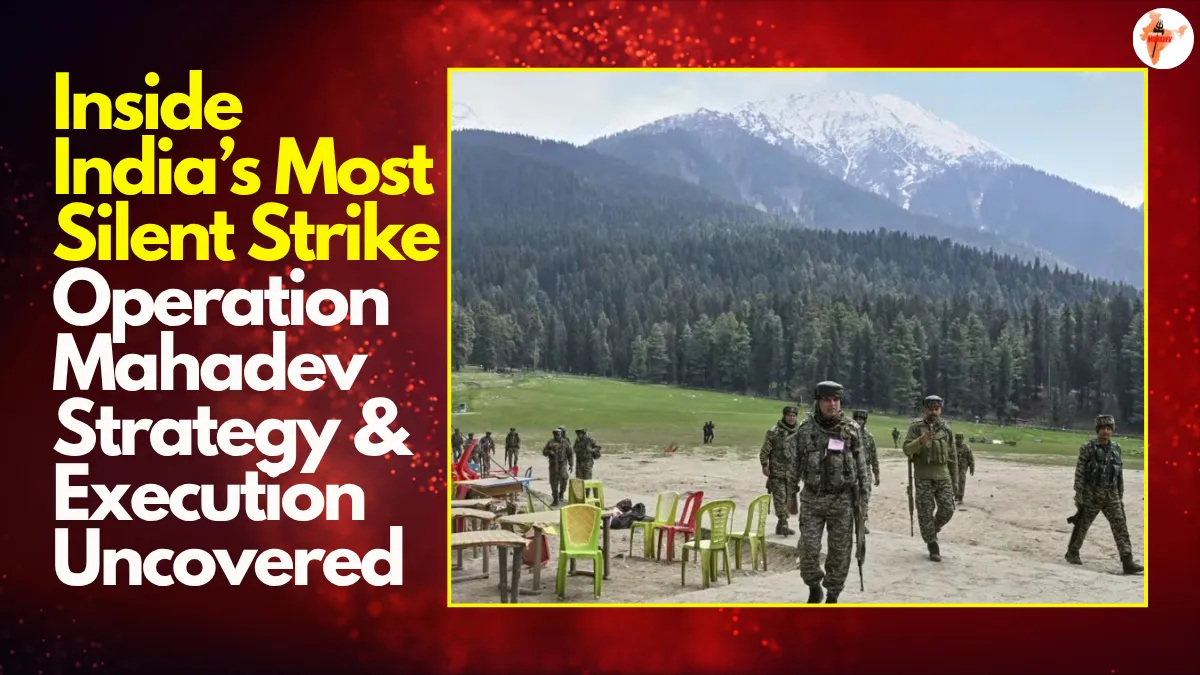
In a region marked by both turmoil and tenacity, Operation Mahadev stood out as a silent yet powerful message of resolve. Launched in response to the Pahalgam terror attack of April 22, 2025, the mission reflected India’s modern, intelligence-led approach to national security—swift, coordinated, and symbolic. Unlike past responses marked by public declarations, this mission unfolded in absolute silence, revealing its results only after achieving complete clarity.
Objective: Precision Over Provocation
The goal of Operation Mahadev was simple yet strategic — to identify and eliminate the individuals directly responsible for the Pahalgam attack. But the mission was not about brute retaliation. It embodied a measured response based on patience, precision, and symbolism.
Indian intelligence agencies worked seamlessly across platforms, leveraging satellite imagery, surveillance data, and ground informants to piece together a detailed movement trail of the suspects. Every action was calculated, ensuring maximum accuracy with minimal collateral impact.
The Role of Terrain and Symbolism
The operation unfolded near Mahadev Peak — a region with deep cultural and spiritual resonance. The name “Mahadev” wasn’t just geographic; it symbolized divine protection, justice, and moral strength. This blend of tactical clarity and symbolic depth sent a powerful message both to citizens and adversaries: India’s response would balance strength with sanctity.
Inside the 14-Day Pursuit
For 14 relentless days, elite units from the Indian Army, CRPF, and Jammu & Kashmir Police collaborated in one of the most synchronized anti-infiltration missions in recent years.
Operating in rugged, high-altitude forests near Mahadev Peak, teams relied on thermal imaging, drone surveillance, and satellite tracking to gradually narrow down the target area. Intelligence breakthroughs came from intercepted satellite phone signals and local informants who helped the forces avoid ambushes and stay undetected.
On July 28, 2025, the operation culminated in a precision encounter that neutralized the three prime suspects responsible for the Pahalgam killings — without a single civilian casualty. The mission is now regarded as a benchmark for coordinated, intelligence-backed counterterror operations in the Kashmir region.
Lessons from Operation Mahadev
The strength of Operation Mahadev lay not in its weaponry, but in its discipline and restraint.
There were no leaks, no theatrics, and no rushed moves — only evidence-based coordination and execution. It showcased how India’s internal security doctrine has evolved to emphasize strategy over spectacle, focusing on lawful, fact-driven, and effective action.
Operation Mahadev – Quick Summary
| Aspect | Details |
|---|---|
| Trigger Event | Pahalgam terror attack (April 22, 2025) |
| Duration | 14 days of continuous pursuit |
| Location | Mahadev Peak region, Jammu & Kashmir |
| Agencies Involved | Indian Army, CRPF, J&K Police |
| Outcome | 3 main perpetrators identified and neutralized |
| Symbolism | Represents divine justice and tactical balance |
| Public Message | India acts with facts, precision, and purpose |
FAQs – Understanding Operation Mahadev
Q1. What was Operation Mahadev?
A precision mission by Indian security forces in July 2025 to eliminate the masterminds of the Pahalgam massacre through a coordinated ground strike.
Q2. Why is it called a ‘silent’ operation?
It relied on discreet intelligence and execution without public announcement — achieving results before the mission was even acknowledged.
Q3. How were the terrorists tracked?
Through a mix of satellite phone intercepts, drone surveillance, and local intelligence, which pinpointed their movements in a forested zone near Dachigam.
Q4. Who were the neutralized operatives?
The primary mastermind and two close aides, all operating under false identities. Weapons and encrypted communication devices found on-site confirmed their roles.
Q5. How long did the planning take?
Planning took nearly three months, with execution only launched once the targets were fully cornered.
Q6. What makes Operation Mahadev significant?
It exemplifies India’s evolving counter-terror model—combining technology, human intelligence, and discipline to achieve justice without collateral damage.
Conclusion: Operation Mahadev represents a new era of Indian counter-terror strategy — silent, precise, and deeply principled. The mission proved that the strongest responses don’t need loud words; they need clarity, coordination, and conviction.
Disclaimer: This article is based on publicly available information and verified reports. It does not disclose classified details or operational secrets.